Undergraduate Honors Thesis (Tier 2 Honors), Department of Anthropology, University of Texas at San Antonio. Submitted 22 June 2007. Thesis advisor: Dr. James McDonald. Readers: Dr. Donald V. Kurtz and Dr. Luz Pérez-Prado.
Download the original scanned thesis (PDF, 56 pp.)Acknowledgments#
Like most human endeavors, this thesis was one, which could not have been accomplished solely by the will of a single individual. I would therefore like to thank my thesis committee, Dr. James McDonald, Dr. Donald Kurtz, and Dr. Perez-Prado, for their patience and willingness to mentor me in this long and arduous process. I would also like to thank my mother Belinda Dillard for instilling in me the confidence and determination to see this project through. Finally, I would like to thank my wife Jennifer, my son Ivan, and my daughter Amelia for their unconditional love and infinite patience over the last two years of research and writing, this thesis was only possible because of my family.
1. Introduction#
In April of 2005, a minor land dispute escalated into the largest political demonstration in Mexico’s history and jump-started Mexico’s presidential election of 2006 eight months early. This land dispute concerned the expropriation of a small plot of private land by the government of Mexico City to build an emergency access ramp to a private hospital. By all accounts, it was a relatively minor land dispute between a municipal government, Mexico City, and a private landowner and therefore should not have affected the Mexican presidential election of 2006. This particular contingency started a presidential campaign so contentious that it proved to be Mexico’s electoral and political institutions’ greatest test since the troubled 1988 Presidential election.
This thesis explores the Mexican presidential election of 2006 through the lens of F.G. Bailey’s neo-processual model and seeks to address and expand upon three primary issues within political anthropology (1970, 2001). The first is the lack of application of Bailey’s model of political competition, which he set forth in Stratagems and Spoils, to national level politics, in particular presidential elections. To address this I examine the strategic use of normative rules within the context of Mexico’s presidential election of 2006. Secondly, I address and build upon the anthropological tradition of processual and symbolic analysis by exploring the role of normative rules within the overall political strategy of the eventual winner of that election, Felipe Calderón of the Partido Acción Nacional (PAN), and his rival, Andrés Manuel López Obrador of the Partido de la Revolución Democrática (PRD) (Bailey 1970, 2000; Cohen 1974, 1981; Kertzer 1988, 1996; Lomnitz-Adler 2001).
Finally, this thesis seeks to examine the Mexican presidential election of 2006 within the context of the use of the normative rules as symbolic weapons. Bailey analogized politics as a game, albeit for very high stakes. As such Bailey declared that political competitions are governed by rules which “…serve as both constraints and resources” for political actors (Bailey 2001:98). In doing so he outlined three general types of rules, the normative rules which tell one how the game is to be played fairly, the strategic rules which tell one how to win the game, and the pragmatic rules which tell one how to cheat or circumvent the normative rules.
Given the emblematic nature of a national political office such as the Presidency of Mexico, the normative rules play an important role in the competition for political power. Political campaigns for presidential office often focus their strategies on emphasizing their candidate’s more presidential qualities while emphasizing the reverse in their opponents. As such, the normative rules act as a resource from which a political actor may draw symbolic weapons of legitimization and de-legitimization. Normative rules used in this way, they are characterized as either formal normative rules or informal normative rules.
In this thesis, the formal normative rules are defined as those codified laws and regulations, which govern the political competition. Because of their codification, formal normative rules represent the culturally mediated and widely recognized limit to acceptable behavior during a presidential campaign, a violation of which might very well disqualify a political actor from the entire game. Conversely, the informal normative rules are based upon more ambiguous notions of right and wrong or in the case of presidential politics, presidential or un-presidential. Additionally, violations of the informal normative type do not necessarily disqualify a candidate from electoral competition. Instead, the informal normative rules speak most directly to the political actor’s ability to symbolize the ideal leader. Questions such as “what are the qualities of a good leader?” or “what do good leaders do?” directly address the informal normative rules. A violation of an informal normative rule detracts from the candidate’s ability to model the ideal leader and hinders the candidate’s success in electoral competition. Strategies that seek to exploit the informal normative will therefore tend to focus on the “intent or spirit of the law.” The informal normative appeals directly to these notions and informs the formal normative, by way of purpose and intent.
As the candidates are competing for a common prize under a common set of normative rules, recognition of the legitimacy of those rules is implicit in the candidate’s participation in the competition and is assumed necessary for participation in the competition. This acceptance and recognition of the legitimacy of the normative rules however is not necessarily equal or complete. This unequal recognition of the normative is most often represented in the emphasis a particular candidate may put upon the formal and informal nature of a particular normative rule. For instance, a political actor who feels that a particular formal normative regulation or the application thereof, is unjust may emphasize how that particular law violates the informal normative ideals of that particular society. Conversely, a political actor who feels that a particular custom is unfairly discriminatory may use a novel interpretation of the law to change that custom. This particular dynamic, as well as a further exploration of Bailey’s model of political competition is contained in the Theoretical Framework section that follows.
While this thesis is not intended to provide a complete accounting of the Mexican presidential election, I have endeavored to analyze those events and contingencies that most exemplify the use and manipulation of formal and informal normative rules as strategic weapons by the candidates and their campaigns. I have divided the election into three main parts the pre-campaign, the official campaign, and the post-election protest. In each of these parts, I explore specific trends, contingencies, and events, which illustrate the dynamic interplay of formal and informal normative rules.
The pre-campaign started with the desafuero, or impeachment, of Andrés Manuel López Obrador on April 7, 2005 and ended January 1, 2006 with the official beginning of the campaign season. This section will provide a short historical backdrop then show how the use of formal normative rules (or codified laws) were used as a symbolic weapon to disqualify López Obrador from the presidential election. López Obrador’s response to this pragmatic use of the “law” was to adopt a strategy that focused upon the informal normative symbol of democracy to circumvent his disqualification. This strategy of emphasizing the informal over the formal not only allowed López Obrador to run for the presidency but also illustrated a possible limit for future formal normative political strategies within the Mexican political arena.
The second part or the official campaign, started on January 2, 2006 lasted until July 2, 2006, Election Day. In this section, I focus on the media strategies of the Calderón and López Obrador campaigns. In particular, the strategic rules concerning political media campaigns and the use of negative campaigning are examined in this section. It was during this time that both López Obrador and Felipe Calderón adjusted their political strategies to emphasize their individual universal representativeness of the Mexican people while deemphasizing their opponents’ representativeness. Each of the campaigns put a strong emphasis upon their candidates’ adherence and embodiment of the informal normative rules while actively denigrating their opposition’s adherence to the same informal normative code. In accusing their opponents though, the candidates had to be mindful that the act of accusing their opponents of malfeasance affected their own efforts at legitimacy building. This mindfulness in essence created the need for two separate, yet integrated, media strategies, which focused upon the positive and negative campaigning. The television commercials presented in this section demonstrate the candidates’ use of the informal normative rules as a symbolic weapon to de-legitimize their opponent.
The post-election protest, which started on July 3, 2006 and ended December 1, 2006 with the inauguration of Felipe Calderón, is also addressed. In this final part of my analysis, I explore the general strategy of López Obrador in his attempt to obtain a full recount of the vote. In doing so, I will briefly layout the political and historical context, which played an important symbolic role in the protest and discuss the disruption of President Fox’s final state of the union address and the prevention of his issuing the traditional presidential grito in Mexico City’s Zócalo. These acts by López Obrador, in effect rituals of de-legitimization, were intended to both discredit Vicente Fox and his administration as well as to allow López Obrador to maintain his core base of supporters within the PRD.
Finally, in my conclusion, I will briefly discuss and explore some of the implications of Mexico’s presidential election of 2006. While the Mexican presidential election of 2006 was quite contentious, Mexico’s electoral institutions not only survived intact but also may have been strengthened by this test. That being said, some of the events that took place during this 20-month period are causes for concern in the upcoming years within Mexico and are discussed in the conclusion.
2. Theoretical Framework#
In Stratagems and Spoils, Bailey used the analogy of a competitive game to describe political behavior of leaders. He defined politics as “that aspect of any act which concerns the distribution of power, providing that there is competition for this power, and provided, secondly, that the competition takes place under a set of rules, which the competitors observe and which ensure that the competition is orderly” (Bailey 1970:223). He assumes, rightly, that the competitors have a shared set of rules and political goals, which govern the competition, and that these rules and goals are unique cultural phenomena. As defined by Bailey the normative code provides boundaries to the competition. Within the context of symbolic strategy, this boundedness also provides a wellspring of resources with which a political actor can overcome his adversary.
As Bailey defined it, the rules of political competition are distinguished between normative, strategic, and pragmatic. Moreover, these rules “…serve as both constraints and resources for contestants and along with goals…” work to shape the strategies of the political competitors (Bailey 2001:98). As constraints, normative rules are seen as prescribing acceptable modes of behavior, be it cooperative or combative. As such, normative rules are the archetypal structure that defines not just the competition but also the political environment in which the competition takes place. Kertzer noted in Ritual, Politics and Power that, “Organizations propagate myths regarding their origin and purpose, whole members engage in symbolic practices that serve to mark them off from nonmember.” (Kertzer 1988:17-18) The normative rules of political competition are an extension of these myths and serve as an extension of the organization’s identity. This archetypal structure is represented and communicated “through both mythic and ritual means” and it is through the process of communication that normative rules take on the aspect of resources (Kertzer 1988:17). As a resource, the normative rules are used as a wellspring of symbolic weapons. When normative rules are used as symbolic weapons, they take on one of two particular forms — the formal and informal.
Cohen noted that elite groups embody “the universal interest of the society” (Cohen 1981:7). This much is borne out by the fact that the competing members of an elite group, such as Mexico’s political class, abide by a set of common normative rules. As such, when members of the political elite compete for political power, they do so by appealing to the universal interest of the whole and in doing so make a claim that they most embody this universal interest. Therefore, elections for political office are a referendum on the political identity of the electorate as a whole. In other words, normative rules, be they formal or informal, are the boundaries by which the competition itself is defined as being particularly Mexican.
Still, normative rules do not tell a competitor how to win. They only act to circumscribe political behavior within culturally acceptable limits and provide resources for acceptable behavior. As such, all normative codes leave open a wide variety of possible social interactions which are described as strategic rules, some of which are “pragmatic evasions of the regnant normative code” (Bailey 2001:198). Bailey defines strategic rules as the means by which a competitor can overcome his political adversaries within the context of the normative rules. Strategic rules, “summarize conventional knowledge” about politics and political competition in such a way as to guide effective political action (Bailey 2001:118). In short, the normative rules are those rules that make the game possible while the strategic rules are those techniques and strategies which make winning the competition possible.
As noted above there exist a subset of strategic rules that are meant “to evade (but do not openly challenge) normative restrictions” (Bailey 2001:98). These pragmatic rules operate as a means of maximizing one’s chances of a victorious outcome. Yet, they are looked upon as being unfair, unethical, and or illegal. Since the competitors are competing for a common goal under a common set of normative rules, it is in the interest of the candidate that such actions remain hidden and out of the public eye. Given the hidden nature of pragmatic rules and the actions they inspire, they lie beyond the scope of this paper. Instead, I focus my analysis upon the public and oft pragmatic use of Mexico’s normative rules and symbols.
Abner Cohen’s conceptualization of the universalistic and particularistic functions of elite groups is analogous to Bailey’s normative and pragmatic rules. Cohen defined elites as a “collectivity of persons who occupy commanding positions in some important sphere of social life and who share in a variety of interests arising from similarities of training, experience, public duties, and way of life” (Cohen 1981: xvi). Cohen noted further that the special status that the elite hold within the society is contingent upon the ability of that elite group to fulfill its universal function. Conversely, the need and or desire to maintain elite status require that the elite group pursue agendas, which are particular to that group. Therefore, political elites lie somewhere on “a continuum from the most particularistic, least universalistic, at one end, to the most universalistic, least particularistic, at the other” (Cohen 1981: xiii). Cohen’s elite functions are analogous to Bailey’s notions of normative and pragmatic rules in as much as the normative rules speak to the larger socio-cultural function of an elite group and the pragmatic to the political self-interest of a particular elite member or elite group. Much in the same way that elite groups exist between the particular and the universal, the political strategy associated with gaining and maintaining elite status exists along a dialectical continuum of formality and informality.
It is within the dialectic tension of the particularistic and the universalistic functions of elite groups, when political actors manipulate the universal normative rules to accomplish a particular political goal, that the normative rules assume the forms of formal and informal rules. The formal normative rules are easily identifiable as those codified laws and regulations most directly pertaining to the competition at hand. While these rules are often subject to some interpretation, their codification gives them a sense of clarity and permanence. This much is demonstrated in the exceptions to a particular formal normative rule and the sanctions for violating a particular formal rule, which tend to be very specific.
The informal normative rules, on the other hand, are characterized by a lack of clarity and are therefore subject to conflicting definitions and interpretations. They are often subject to a “you know it when you see it” interpretation. Application of these rules is often subject to the particular historical and social context in which they are applied. Therefore, exceptions to the informal normative rule are often much less specific then what might be expected under the formal normative rules.
As is often the case in political competitions, a great deal of rhetoric centers on accusations of particular rule violations, be they “serious” legal violations or violations of cultural norms. The primary characteristics of formal normative rules, outside of their codification, are the particular strategies that they inform. These strategies tend to focus on the “letter of the Law.” Conversely, the informal or non-codified, focus on the “intent of the Law” and is more often associated with strong yet abstract and ambiguously notions of right and wrong. The informal normative rules appeal directly to these notions and inform the formal normative rules by way of purpose and intent.
The process of using a normative rule as a symbolic weapon brings pragmatic and particularistic purpose into the political strategy, which transforms the archetypal normative to meet the pragmatic realities of the mundane world. However, formal and informal rules do not directly oppose each other; instead, they are the result of the dialectic tension between normative ideals and pragmatic realities. Formal and informal rules complement each other in a larger and much more dynamic process of the social contract. The opening days of Mexico’s 2006 presidential campaign season illustrate this process quite well.
3. The Desafuero of López Obrador#
Prior to López Obrador taking office as head of the Government of the Federal District, the government of Mexico City had been contracted, by a private hospital to construct an access road which would connect the hospital to Mexico City’s freeway system. In pursuance of this López Obrador’s predecessor, Rosario Robles expropriated a 200-meter strip of privately owned land that was part of a larger property known as El Encino in Santa Fe, Cuajimalpa, on November 9, 2000. On March 11, 2001, the owner of the property, Promotora Internacional, filed a lawsuit against the city and a federal judge granted an injunction barring further construction until the case had been decided. In response, the hospital threatened the city with a multi-million dollar lawsuit if it did not fulfill the contract within the designated time specified in the contract.
Soon after López Obrador became Mayor of Mexico City, he was faced with the unenviable choice of either ignoring the court order and fulfilling the contract or obeying the court order and breaking the contract. If he had chosen to obey the court order, he would have subjected the city government to a multi-million dollar lawsuit for breach of contract with the hospital. Such a lawsuit would have seriously hampered his political agenda of jobs creation, infrastructure improvement, and the creation of a social safety net for Mexico City’s poorest residents. If, as he did, choose to ignore the court order he would have committed a misdemeanor offense that would have exposed him to possible impeachment through a legal process called desafuero.
Mexican politicians are protected from prosecution while holding office through an immunity known as fuero and that immunity may be removed through a process called desafuero. This process is grounded in the most normative and formal of the Mexican normative code, namely the Mexican Constitution. According to Article 38.II1 of the Mexican Constitution, individuals who are “subject to a criminal process…,” have their rights and duties as citizens suspended. In other words, López Obrador’s desafuero would have forced him out of the Office of Head of Government of the Federal District and seriously crippled his future political prospects.
On December 13, 2001, the court issued a criminal complaint to Mexico Attorney General, Rafael Macedo de la Concha, a PAN party member and neo-liberal activist, charging abuse of office on López Obrador’s part. In an article in Reforma, a major Mexico City newspaper, dated 13 December 2001 Fernando Perez Correa, a lawyer for the plaintiff Promotora Internacional, was quoted as saying that their legal strategy was to initiate the process of desafuero.
Refirió que si la instancia determina que se configura el delito de abuso de autoridad, tendría que solicitar un juicio de procedencia contra el Jefe de Gobierno para su desafuero, ante la Cámara de Diputados, única facultada para declarar que es posible ejercer acción penal en su contra. (Pérez 2001).
Author’s translation:
“If the crime of abuse of office is formed, he would have to ask for a judgment of origin against the Head of Government (López Obrador) for his violation (his refusal to obey a federal court order), before the House of Representatives, to declare that it is necessary to prosecute criminal action against López Obrador.”
After a very methodical three-year investigation, Attorney General Macedo de la Concha formally initiated the desafuero process in late 2004. The timing of the desafuero made it very likely that López Obrador would be disqualified from running for the presidency. To make matters even more dramatic, by late 2004 López Obrador was maintaining a commanding 10 to 12 point lead in the polls as well as maintaining a high approval rating for his mayorship of Mexico City. As such, it was widely suspected at the time that Macedo de la Concha purposefully delayed the investigation so that the desafuero would disqualify López Obrador from the 2006 presidential election. By April of 2005, López Obrador was considered a shoo-in as the PRD presidential candidate and the odds on favorite to win the upcoming presidential election.2 Therefore, the desafuero of López Obrador created the perception of official abuse of power by the Fox administration, among the electorate. This perception was reinforced by the fact that the PRI and the PAN legislators in the Cámara de Diputados had recently formed a majority alliance to support the desafuero of López Obrador.
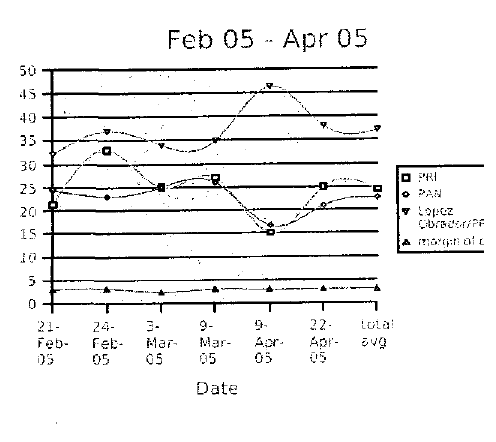
Illustration 1: Notice that López Obrador’s numbers are the highest just two days after his desafuero.
While it is obvious from the above quote that Promotora Internacional’s lawyers were attempting to use the threat of desafuero as a means to leverage a more satisfactory compensation from the Mexico City government, it is difficult to prove that the PAN and the PRI had been conspiring since 2001 to block López Obrador from running for the presidency of Mexico. The above contingency does illustrate the use of the formal normative rules to meet the particularistic goals of the PAN and the PRI as elite groups. In doing so, however, they violated the informal normative and universal conceptions of fair play. This allowed López Obrador to respond with a political strategy that focused solely upon the informal universalistic norms of democracy.
López Obrador countered with a shrewd strategy, which drew upon Mexico’s revolutionary symbolism through political martyrdom. This strategy emphasized a very informal normative approach by characterizing the accusations of his violation of the formal normative rules (i.e., ignoring the court order) as a legal rationalization of a pragmatic violation of the regnant normative code; namely the undemocratic disqualification of the candidato del pueblo López Obrador. The strategy of political martyrdom was specifically designed to appeal to this violation of the normative code by invoking the historical comparison to Francisco Madero. The relative weakness of the PRD in the Mexican congress therefore proved to be an asset rather than a liability as it gave the perception that the people of Mexico, whom López Obrador claimed to represent, was again being cheated by Mexico’s political elite. This perception was an absolute necessity if López Obrador’s plan of political martyrdom was to succeed.
In defending himself, López Obrador illustrated this strategy when he said, “Como lo sabe la mayoría de la gente en el país, mi desafuero no es un asunto jurídico sino político, aunque esta canallada la quieran envolver con una hipócrita devoción por la legalidad” [author’s translation: As most of people in the country know, my crime is not a legal subject but political one, although this vile trick surrounds itself with a hypocritical devotion to legality].3 In accusing his political enemies as having a “hypocritical devotion to legality,” López Obrador was emphasizing the contradiction of using the formal normative “Law” to obstruct the “democratic” process and prevent a widely popular candidate from running for office.
On April 7 of 2005, López Obrador prepared himself for his political martyrdom and surrendered himself for judgment before the Cámara de Diputados. In his speech before the Mexican Congress that day, López Obrador characterized his desafuero as a cynical attempt to silence the will of the people, while at the same time framing himself and his current political situation in the historical light of Francisco I. Madero.
Efectivamente, es un atentado incalificable el que se ha cometido conmigo, pero ha servido para quitar definitivamente la careta a nuestros gobernantes, para exhibirlos como tiranos vulgares y para desprestigiarlos completamente ante la opinión pública, a la vez que nuestro partido se ha fortalecido de manera increíble. Por estas circunstancias no me aflige mi prisión, pues aquí descansando, creo que estoy prestando grandes servicios a nuestra causa.
Author’s translation:
“Indeed, this is an unspeakable attack that has committed against me, but it has served to definitively remove the mask to our governors, to exhibit them like vulgar tyrants and to completely discredit them before the public opinion, simultaneously that our party has been fortified in an incredible way. By these circumstances my prison does not afflict to me here, because I believe that I am serving great to our cause.”4
López Obrador created a narrative that established his struggle for political power in the guise of a “popular democracy” that was part of the larger mythological narrative of Mexico’s revolutionary heritage. As such, he announced that, like Francisco I. Madero, he would run for president from his jail cell if need be.
The overwhelming support that he received during the protest rally of April 7 of 2005 combined with the overtly political and pragmatic nature of his desafuero proved to be reminiscent of other recent populist movements for democracy, such as the Ukrainian Orange Revolution and the Lebanese Cypress Revolution. These similarities between the Mexico City protest and the Orange Revolution helped to increase the national and international political pressure on President Fox and his administration to remedy the situation immediately. Realizing their party’s strategic weakness, should López Obrador run for the president from his jail cell, several PAN Senators posted López Obrador’s bail. This act mitigated the political damage that would have been done by the symbolism of a popular candidate for president being detained in jail for political reasons.
The posting of López Obrador’s bail, by the PAN, denied him the full use of the symbolic weapon of political martyrdom. The issue of his disqualification remained and pressure from the media, NGOs such as the Carter Center, Mexican intellectuals and some members of the PRI and PAN, was brought increasingly to bear on President Fox to resolve this situation immediately. Soon thereafter President Fox fired the Attorney General, Macedo de la Concha, and replaced him with Daniel Cabeza de Vaca Hernández, who later dropped the charges against López Obrador, thereby freeing him to run as the PRD presidential candidate.
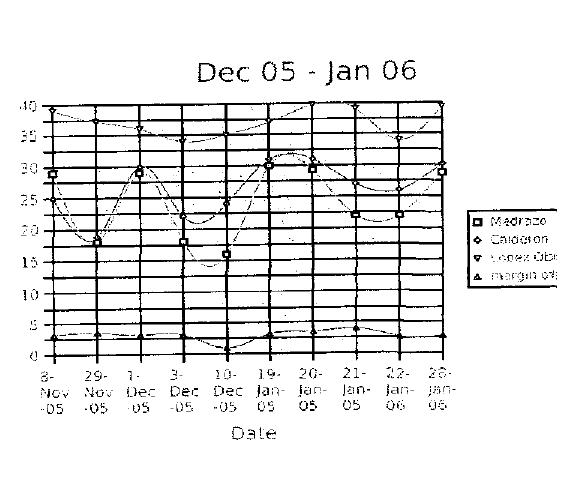
While López Obrador was unable to fully capitalize from the symbolic advantages that his political martyrdom would have offered he did emerge from his desafuero as the leading candidate for office. López Obrador’s early lead in the presidential race turned out to be a mixed blessing. While all the presidential candidates envied his 10 to 12 point lead in the public polls, López Obrador’s lead also made him a conspicuous target in the media strategies of his opponents.5 In the following section, the media strategies of the Calderón and López Obrador campaigns are compared and contrasted to reveal the underlying themes of the political discourse in Mexico during the 2006 Presidential Election.
4. Media Strategy: the Alchemy of Fear and Hope#
Given that the Calderón and López Obrador campaigns collectively captured 71% of the vote in 2006, it is not surprising that the media strategies of these two campaigns reveal insights into Mexico’s strategic rules of political competition. In capturing 71% of the vote, the Calderón and López Obrador campaigns demonstrated an understanding and acceptance of the strategic rules of the Mexican political arena. As they were both appealing to the same electorate, it is not surprising that they would generally follow the same set of strategic rules. This is not to say, however, that their media strategies were the same. Instead, the particular media strategy reflected the candidates understanding of the Mexican political arena, and more importantly, of the Mexican electorate. This is especially evident if one considers the tactics and symbols through which each of the campaigns implemented their strategies.
The tactics of “how to attack?” and “how to respond to an attack” enter into the calculus of strategizing and are informed by the desire to maintain the presidential facade. The tension created by the need to de-legitimize one’s opponent while maintaining an aura of “being presidential” gives rise to the strategic and pragmatic rules of presidential campaigns. The first such rule concerning political media strategies is the division of the overall political strategy into positive and negative media campaigns. The positive media campaigns tend to be centered on the representativeness of the candidate to the collective ideal of the president as a symbolic representation of the electorate. The ultimate purpose of the positive media strategy is the transformation a presidential candidate into the representative ideal of the whole, the ideal mythical president. As a result, positive media campaigns orient themselves with the normative code of the group and the universalistic purpose of the office of the president.
The tactics and symbols used within each of the campaigns’ media strategies reveal the context of the candidates in that they are interpretations of the normative rules. The Calderón campaign, for instance, created a series of advertisements that featured Felipe Calderón dressed in a blue cardigan sweater in his home office as he talks about his family, honesty, and security.6 Other ads featured endorsements from members of Mexico’s national soccer team, who incidentally were representing Mexico and faring quite well in the 2006 World Cup.7 These ads in particular note that Calderón, like the electorate had, a “passion for Mexico’s” soccer team. In this case normative code dictated that he be seen as enthusiastically supporting Mexico’s national team. The purpose of these series of commercials was to show how Calderón, like most Mexicans, was an honest man who is concerned about his young family and their security by way of his rhetoric and imagery. There is also a strong symbolic focus, upon his relative youth and the future, by way of his rhetoric and the imagery. The theme of these advertisements sought to emphasize Calderón’s positive outlook for the future, his youthful energy, and his family, in a direct appeal to Mexico’s burgeoning middle class.
While economists may argue over whether Mexico’s middle class is growing, much less burgeoning, it should be remembered that the purpose of these ads is not to accurately portray the current state of Mexico’s economy. Instead, these particular advertisements are trying to create and reinforce the perception that Mexico has a burgeoning middle-class, the existence of which is due to the policies and leadership of Calderón’s fellow PAN party member President Fox. This was an appealing overture for those who did see some improvements in their lives since over the last 5 years of the Fox administration. Even for those who had not seen much improvement during the Fox administration, Calderón’s commercials offered hope through the informal normative values of hard work and playing by the rules.
Conversely, López Obrador’s positive media campaign focused upon images of Mexico’s past. As with the Calderón campaign, there was a strong emphasis upon the family. However, the focus was not upon the future but on the present economic circumstances of Mexico’s poor. In one particular commercial, a young girl is seen talking with her friend about her father who has emigrated from Mexico to the United States to support their family. As the girl talks of her father, she begins to cry and declares that she misses her father and wishes that he did not have to go to America to provide his family. As the girl cries her friend hugs her and the scene fades to a smiling López Obrador, the implied message being that López Obrador will create jobs in Mexico so that fathers do not have to leave their families anymore.8
Another commercial features a slow, dramatic soundtrack with short video clips and pictures of López Obrador addressing large crowds, surrounded by cheering people, and dancing with little old women. As each of the scenes appears, one-word statements are superimposed on the images, which symbolically reference highly normative conceptions, such as humanity, sensibility, authenticity, and patriotism. The commercial ends with the following line: “Cando a un hombre le segue un pueblo enter, es parquet el heart en sues Manos lava.” [author’s translation: When the whole town follows a man, it is because he takes their heart in his hands.] The short statements and imagery used within this commercial emphasize the social contract as a sacred trust between the people and the leadership. As such, the imagery within this commercial emphasizes López Obrador’s representation of the mythical Mexican president as a man of the people. The words superimposed upon the images as well as the final statement reify the sacred trust between the people and their elite leadership.
As noted earlier, each of the campaigns had a second component that I labeled as the negative campaign. Negative campaigns in Mexico during the 2006 presidential campaign were opportunistic in their choices of strategy and symbols. By this I mean that both the Calderón and López Obrador campaigns almost exclusively used their opponents’ own words, deeds and actions to de-legitimize them in front of the electorate. As such, there is a strategic emphasis on quick reactions to contingencies created by the opposition, be it intentional or otherwise. Furthermore, the negative campaigns had themes that almost exclusively used fear to de-legitimize the opposition.
The Calderón campaign skillfully created a negative campaign theme, which relied upon the opposition’s own strategic missteps. With the overarching theme of “López Obrador is a danger to Mexico”, Calderón’s attack ads took advantage of López Obrador’s strategic miscalculations as well as his controversial past as a political activist in his home state of Tabasco. Of these strategic miscalculations there were two in particular that proved to be very fruitful for Calderón and very damaging to López Obrador.
Calderón started the campaign off in January as a veritable unknown on the national political stage. In order to gain ground in the election, and make a name for himself, it was important that Calderón begin to destroy the aura of presidentialism that surrounded López Obrador. Operating on the assumption that it is much more effective to pull oneself up, if you are also pulling your opponent down, Calderón enacted a strategy that emphasized the un-presidential behavior of López Obrador. Fortunately for Calderón, Venezuelan President Hugo Chavez made his strategy that much more effective by providing himself as a caricature of the dangerous outsider.
On November 10, 2005, Hugo Chavez gave a speech, one month prior to participating in the Free Trade Area of the Americas (FTAA) in Buenos Aires, Argentina. In that speech he caricatured President Fox as not living up to what he thought the Mexican people should expect from their leadership. In particular, President Chavez called President Fox a “puppy dog” of the Americans for his support of U.S. trade interests in the upcoming talks. Just prior to leaving for the talks, President Chavez would say on his weekly television talk show, Aló Presidente,9 that the Vicente Fox was “bleeding from his wounds” and that Fox should not “mess” with him, lest he “get stung.” Upon hearing these further remarks, President Fox threatened to recall the Mexican ambassador from Venezuela unless President Chavez promptly issued an apology (BBC News: 2005, 2005a). President Chavez, however, recalled the Venezuelan ambassador from Mexico, at which point President Fox withdrew the Mexican ambassador the following day. While López Obrador was not involved or connected with President Chavez and his comments preceding the FTAA meeting, comments he made during a speech in March of 2006 resembled President Chavez’s insults.
López Obrador, while responding to remarks made the previous day by President Fox about López Obrador told Fox to “cállate chachalaca,” or “shut-up you noisy bird.” Intended and received as a joke by his immediate audience, López Obrador’s comments showed him to be rash and temperamental, qualities which are perceived as being un-presidential. The coarseness of the language that López Obrador used to refer to the President Fox appeared to show a certain level of disrespect for the office of the President of Mexico - the same disrespect that President Chavez showed when he insulted President Fox prior to the 2005 FTAA meeting four months earlier. Given the universal representative nature of the Office of the President to the Mexican people, such disrespect was as much a slight against them as it was to Vicente Fox.10
The use of his rival’s political miscalculations suggests that the Calderón campaign was very aware of the informal rule of “proper respect” for the presidency of Mexico and was willing to use it as a symbolic weapon to de-legitimize his opponent. So powerful, was this accusation of disrespect that it occupied much of the news during the months of March and April and marked the beginning of López Obrador’s downward trend in the polls. Additionally, López Obrador was put in the uncomfortable circumstance of having to defend President Fox, his political enemy, in the media.11
While 4 months had passed since the Chavez remarks, they were still fresh enough in the minds of the Mexican electorate that, when used in conjunction with López Obrador’s remarks, these commercials created a visage of López Obrador that was anything but presidential. In doing so, this attack ad used the informal normative ideal of proper respect for the people and presidency of Mexico and contrasts this ideal with López Obrador’s words. Adding fear of the outsider to the symbolic mix, this contradiction is then compared to Venezuelan President Hugo Chavez and thereby marked López Obrador as not only unrepresentative of the Mexican people but as a danger to them.
Another strategic mistake, which Calderón used against López Obrador, was the latter’s refusal to participate in the first presidential debates held on April 25, 2005.12 López Obrador had previously stated that he would only participate in one debate and had chosen to sit this one out. The other candidates though decided to leave an empty chair on the stage to symbolize that López Obrador had been invited to participate. By itself, López Obrador’s failure to participate in the first debates probably would not have been enough to damage his standing with the electorate. However, the use of empty chair worked as a powerful symbol and proved to be a shrewd move by López Obrador’s opponents and it appeared frequently on the televisions of millions of Mexican voters.
In one particular commercial the image of the empty chair was featured with footage of the mêlée with police that took place during the 1996 PEMEX protest that López Obrador had organized, as well as footage of López Obrador excusing the lynching of police officers in the Mexico City suburb of Tlaplan while he was mayor of Mexico City.13 The emphasis of these commercials reveals that the overall theme of Calderón’s negative campaign was to create an atmosphere of fear around López Obrador should he become president and thus labeling him as “a danger to Mexico.”
In response López Obrador, launched a two-pronged strategy against Calderón. The first prong was a formal normative strategy and consisted of a formal complaint to the IFE charging that Calderón’s attack ads broke Mexico’s Instituto Federal Electoral (IFE) regulations by using false information to defame him. The IFE or Federal Elections Institute is charged with regulating Mexico’s federal elections. The IFE has the power to enforce Mexico’s election laws and regulations and is therefore the primary arbitrator in all federal electoral disputes. The IFE judgments however are not final. They may be appealed to the Tribunal Electoral del Poder Judicial de la Federación (TRIFE), which is Mexico’s supreme electoral court and has the final say in all electoral disputes.
The second prong of López Obrador’s strategy was to launch his own series of attack ads. In one particularly inflammatory attack ad14, Felipe Calderón is compared to notorious fascist dictators such as Francisco Franco, Adolph Hitler, Josef Stalin and Pinochet. López Obrador’s attack ad resembled a Power Point presentation and was composed of pictures of these dictators. As each dictator appeared on the screen strikingly similar quotes such as “La republica es un peligro para España” [author’s translation: The Republic is a danger to Spain] or “Allende es un peligro para Chile” [author’s translation: Allende is a danger to Chile]. The final picture is one of Felipe Calderón with the tag line “López Obrador es un peligro para Mexico” [author’s translation: López Obrador is a danger to Mexico]. Like Calderón’s commercial, this one uses the candidates own words to emphasize the point. The commercial ends with the following statements: “El miedo es mal consejero. Vota por quien tu quieras. No votes con miedo” [author’s translation: Fear is a bad advisor. Vote for whom you want. Do not vote with fear.] The commercial evokes the informal normative notion of an informed and rational vote and compares this notion to the contradictory tactics of fear that is present in the Calderón attack ads.
Ironically though this commercial demonstrates López Obrador’s use of fear to motivate the electorate to support his campaign. In comparing the Calderón quote to those of Hitler, Franco and Pinochet, López Obrador plays on the fear of fascists and totalitarian dictatorship. While López Obrador’s negative campaign strategy was just as effective as Calderón’s in their power to de-legitimize, López Obrador’s use of these tactics resulted in the negation of his legal complaint, with the IFE, that Calderón’s ads were untruthful and defamatory (McKinnley 2006).
5. Post-Election Protest and Rituals of Humiliation#
On Election Day, and after over a year of cutthroat politicking and fear mongering, the Mexican electorate finally had the opportunity to have their voices heard. However, any hope that the end of the day would also bring an end to Mexico’s extended campaign season ended when the IFE revealed that the Programa de Resultados Electorales Preliminares (PREP) would be delayed due to the closeness of the race. Mexico’s electoral laws mandate that the PREP provide a quick estimate of the electoral results. The PREP, however, has no legal authority to determine the outcome of the election but is considered the IFE’s prediction of who will win the election. The IFE notes on its website that the PREP is accurate in predicting the eventual winner if the difference between the two candidates is greater than 1% with 98% of the vote counted, a condition that was not met with this election.
At about 7:30 pm, one of the most trusted pollsters in Mexico, Consulta Mitofsky announced that it could not accurately determine who the eventual winner might be because the race was just too close to call using exit polling data. The closeness of the election would be confirmed by Dr. Luis Ugalde, President of the IFE, when in a nationally televised announcement, he said that the PREP report would be delayed and counting would have to continue into the night before an accurate prediction could be announced.
Immediately following Dr. Ugalde’s speech President Fox addressed the nation. He too tried to head off any suspicion that the electoral process might be corrupted. Like Dr. Ugalde, he also praised Mexicans for their participation and said that they should have faith in their electoral institutions. Many other members of the social and political elite echoed these reassurances of electoral transparency in addition to the appeals to calm and patience that were issued by President Fox and Dr. Ugalde throughout the day. These reassurances of electoral transparency and the appeals for calm show that there was a strong underlying fear of violence and political instability should the election prove to be as close as it was.
This scenario now seemed to be coming to fruition when both Felipe Calderón and Andrés Manuel López Obrador claimed victory that night. Given Mexico’s troubled electoral history as well as the closeness of the race and the inflamed passions that drove the rhetoric of the campaign, this delay only reinforced suspicions of a corrupted electoral process among López Obrador’s supporters. Adding to this suspicion was the fact that, in 2003 the PRD was shut out of the IFE Board elections by a PAN/PRI coalition and therefore had no representatives on the IFE Board. The IFE board was therefore, filled with individuals who owed livelihoods to the PRI and the PAN. From López Obrador’s perspective, since the referees in that arena were biased against him he had very little chance of winning the election should the election prove to be close.
This perspective was communicated to the public by López Obrador in a June 26th interview with El Universal, where he was quoted as saying that he would respect the results of the election only if there was a “Claro dijo, estamos hablando de un proceso limpio, de una elección libre, legítima, que se debe respetan” [author’s translation of: a clean (electoral) process, a free and legitimate election, that is worthy of respect].15 He went on to say that Mexico’s “cúpulas y líderes muy politizados, que ni siquiera reflejan la postura de aquellos a quienes dicen representar” [author’s translation: political elite are much politicized, and they do not reflect the position of those they say they represent].
The above statements also revealed that in the event that he lost the election, López Obrador’s strategy would be to de-legitimize not just Felipe Calderón, but those largely unnamed members of Mexico’s political and bureaucratic elite that ran Mexico’s electoral institutions. This strategy would be heavily dependent upon the use of informal normative notions of popular democracy over the formal institutions of democracy. To do so López Obrador had to illustrate that the election and the institutions that ran the election had been corrupted by his political enemies.
If, however, López Obrador was to prevail and attain the Presidency of Mexico he would have had to prove his case within the context of the institutions which he claimed were corrupted. It was this context that created the rhetorical paradox of de-legitimizing those running the Mexico’s electoral institutions while maintaining support for the institutions of electoral democracy, in which López Obrador found himself. By recognizing the legitimacy of the electoral institutions while at the same time accusing those who ran those institutions of having a bias against him, López Obrador created a contradiction that worked against his argument.
The public response to this contradiction also highlights a fundamental cultural understanding that what is often anthropomorphized as Mexico’s electoral institutions, is nothing more than individuals exercising their agency under a cohesive set of rules and cultural norms to accomplish a public goal. Therefore, to question the legitimacy of the rulings of those who ran the IFE and TRIFE calls into question the legitimacy of the institution itself. It is reasonable to assume that roughly two-thirds of the Mexican electorate (those who had voted for the PAN or PRI candidates and not for López Obrador) was working from this premise and did not support López Obrador’s protest because they recognized the legitimacy of the electoral institutions he was challenging. Given the high degree of legitimacy that Mexicans had of their electoral institutions,16 this strategy had little chance of success.17
On election night, López Obrador enacted his post-election strategy from his campaign headquarters at the Hotel Marquise in Mexico City. In his statement to the press that night, López Obrador noted that,
Voy siempre a ser respetuoso de las instituciones y de manera particular de lo que en definitiva resuelva el Instituto electoral. Sin embargo, quiero informar al pueblo de México que, de acuerdo con nuestros datos, ganamos la Presidencia de la República. Tenemos información de conteos rápidos en donde estamos, cuando menos, 500 mil votos arriba… Exijo, pido, a las instituciones electorales que respeten nuestros resultados. Voy al Zócalo a hablar con la gente, a informarles, yo creo que este resultado es irreversible, es decir, que triunfamos, que ganamos.
Author’s translation:
“I am always going to be respectful of the institutions and particular way of which really she solves the electoral Institute. Nevertheless, I want to inform to the people of Mexico that, in agreement with our data, we gained the Presidency of the Republic. We have information of fast counts (exit polls) in where we are, at least, 500 thousand votes above…I demand, I request, that the electoral institutions respect our results.”18
Later López Obrador’s critics would charge that his “demand” that his election results be respected was unreasonable and was yet another sign of his autocratic nature. While this criticism may be valid, it conveniently leaves out the political context in which López Obrador was operating. As such, we gain little in understanding as it concerns the political and historical context in which López Obrador was operating.
Part of this political context lies in the founding of the PRD and the troubled presidential election of 1988. In 1988, Cuauhtémoc Cárdenas, after being expelled from the PRI for trying to democratize their nomination process, ran for president under the banner of the Frente Democrático Nacional (FDN). The FDN was a coalition of small left-wing parties and Cárdenas’s fellow PRI dissidents. Carlos Salinas de Gortari of the PRI, in what is widely believed to have been a fraudulent election, defeated Cárdenas. Cárdenas chose not to take to the streets in protest over fears of what this might result in violence. For many of the left, who had been politically and violently suppressed during Mexico’s “dirty war,” the uncontested loss of the 1988 election was a disappointment that they were unwilling to face again in 2006. López Obrador’s overall strategy is a reflection of his understanding of this political reality. If he was to maintain some level of political relevancy within his own party, he could not be seen following the path of passive submission, as did Cárdenas. Therefore, in order to maintain his position and base of support within the PRD, it may not have been politically viable for him to give up and go home as Cárdenas had done.
On the other hand, he was also determined to model his movement as a nonviolent revolution similar to that of Martin Luther King Jr., Gandhi, and, more recently, Viktor Yushchenko of the Ukraine (López Obrador 2006). He hoped that such a strategy would eventually lend his movement the legitimacy, both nationally and internationally, that he sought. In pursuit of this goal, López Obrador, in the following weeks, began to gather hundreds of thousands of protesters to Mexico City to pressure for a “vote-by-vote” recount of the ballots. By the end of July, these demonstrators became an occupying force as López Obrador stepped up the pressure by blocking 12 kilometers of the Paseo de la Reforma, which houses several important hotels, corporate main offices and the Mexico City Stock Market.
Given that López Obrador was calling into question, the legitimacy of the IFE within the context of Mexico’s institutions his only recourse was to appeal to the Mexico’s supreme electoral court, the TRIFE, for a recount of the vote. López Obrador claimed in his complaint to the TRIFE that there were irregularities in 54% of polling stations and demanded a “vote by vote” recount of all polling stations. However, on August 5 the TRIFE rejected this request on the basis that it did not have the authority to order a vote-by-vote recount of all of the polling stations. This decision was based upon articles 41 and 99 of the Mexican constitution, which requires that if a ballot count goes unchallenged its results are considered valid and further judicial review is not required. The TRIFE noted that López Obrador was legally “tied to respect the tallies certified by the citizens in the polling stations not in controversy.” Thus, the 46% of the districts, which López Obrador did not challenge, were determined to not require a recount. Additionally the TRIFE determined that they were only required to recount enough of the polling stations to determine if the electoral process was corrupted. Therefore, they only recounted 9.7% of the polling stations.
López Obrador built a case against a “very powerful group of privileged people” or elites who really run the Mexican government. He characterized this group of privileged elites of being opposed to his economic policies toward the poor and did not want to see the majority of Mexicans improve their situations. He went on to say that these elites were determined to win at any cost and had corrupted Mexico’s electoral institutions and prevented the vote-by-vote recount, which would have proved that he was the winner. As López Obrador saw it, he and his supporters had the “obligation to defend the democracy and everything that it implies.” This passage reveals that a large part of López Obrador’s strategy was to appeal to the informal normative ideals of “democracy” and thereby de-legitimizing those running Mexico’s electoral institutions as supporting the undemocratic economic agendas of Mexico’s political elite and their foreign supporters over the average Mexican.
On September 5, 2006, the TRIFE issued its decision that election of Felipe Calderón was valid and legitimate. This announcement by the TRIFE confirmed what most Mexicans already knew; that López Obrador’s political strategy of gaining the Presidency of Mexico through political protest had failed and Felipe Calderón would be the next President of Mexico. Reflecting this attitude monito, a blogger and graduate student, wrote the following about the inevitability of this on his blog Un Mono Ocupado:
Si el IFE le da la constancia de mayoría (eso podría ser hasta septiembre), él será el próximo presidente de México y guste o no guste, se votará por él o no, tendrá que gobernar a todos, a los 14 millones que votaron por él y a 106 millones más (entre abstemios, opositores e infantes), así que la pregunta de si estoy de acuerdo es realmente irrelevante.
Sí él gano (y todo parece indicar que sí), el nos gobernara y que bueno que el que obtenga más votos se convierta en el presidente y no quien mejor nos caiga, de lo contrario el margen tan pequeño de victoria (cuatrocientos mil votantes) crearía incertidumbre e ilegitimidad y creo que México no se lo merece. En todo caso, Andrés Manuel no ha reconocido su derrota, porque todavía no pierde, esto no se acaba hasta que se cuenten todos los votos y existe certeza de que 3 millones de votos no se contaron por inconsistencias en el llenado de las actas. En el caso de mi casilla, un acta fue invalidada y no contó, porque el menso que la lleno, hizo de su letra algo ilegible, pero en ese caso es culpa de todos, del que hizo el acta, de los representantes de partido y del propio IFE por no buscar maneras de evitar errores tan pueriles.
De corazón, viva México, viva la Democracia y la Legalidad.19
Translation courtesy of David Sasaki of GlobalVoicesOnline.org
If the IFE gives proof of the majority (this could take until September), [Calderón] will be the next president of Mexico and, like it or not, whether you voted for him or not, he will have to govern everyone: the 14 million that voted for him and the 106 million more (among abstentions, opposition, and soldiers). Therefore, the question of whether I agree with him or not is irrelevant.
If he won (and everything seems to indicate yes), he will govern us and, well, he who obtains more votes becomes president, not he who we get along with best. Otherwise, the very small margin of victory (400,000 votes) would create uncertainty and illegitimacy and I do not think Mexico deserves that.
In any case, Andres Manuel (López Obrador) has not recognized his defeat, because he has still not lost. This does not end until they count all the votes and there is certainty about the three million votes, which were not counted for inconsistencies in the filling out of the ballots. In the case of my polling place, a ballot was invalidated and not counted because the dummy that filled it out had illegible handwriting, but in that case, it is the fault of everyone: the person who made the ballot, the representatives of the party and the IFE for not seeking manners to avoid such trivial errors.
From the heart, long live Mexico, long live democracy and legality.20
While López Obrador has not recognized the legitimacy of President Calderón, it had increasingly become apparent that most of Mexico had reached the same conclusion as monito had. Through the whole summer of 2006, various public-polling agencies released surveys, which collectively illustrated a trend away from López Obrador and his claims of corrupted electoral institutions.21
Despite this generalized loss of support among the general population and the formalized end of his struggle to attain the Presidency of Mexico, López Obrador steadfastly refused to call off his protest and instead began to focus his strategy at ritualistically humiliating President Fox. To do this López Obrador had to symbolically emasculate President Fox, to show that even the President of Mexico was powerless in the face of “the people’s choice”. With this in mind, López Obrador and the PRD initiated a series of protests which were aimed at humiliating President Fox by disrupting his constitutionally mandated State of the Union speech as well as his giving the traditional Independence Day grito.
On 1 September, President Fox was to give the State of the Union speech in front of a joint session of the Mexican legislature. He was prevented from doing so by PRD legislators who had taken over the dais and blocked President Fox from giving his final State of the Union speech. This forced President Fox to comply with his constitutionally mandated State of the Union speech by handing in a copy of his speech to his party’s congressional delegates and instead televise his speech from Los Pinos, the presidential mansion.
The whole incident played out live on television. Mexicans woke up and found that their normal morning gossip show was preempted several times to cover the floor of the Cámara de Diputados. As the day got later, the newscaster went to full time coverage.22 Fistfights broke out as the PAN congressional delegates began to try to dislodge the PRD congressional delegates from the dais. In between the fights and occasional interview, news anchors revisited all of the sordid details of the Presidential election. When President Fox arrived to give his last state of the Union address, he was barred from entering the chamber. The news showed President Fox fulfilling his formally normative responsibility by handing in his speech. They also showed President Fox’s failure to fulfill his informal obligation of reading his speech before Congress. Mexicans watched this humiliation as the PRD congressional delegation chanted “voto por voto, casilla por casilla” (author’s translation: “vote for vote, box for box”). This marked the first time in Mexican history that a president was prevented from giving his annual state of the union address. It showed President Fox to be powerless to fulfill his ritual duty of delivering his state of the union address in front of the Mexican Congress.
A few days later López Obrador called for a “National Democratic Convention” to be held on September 16, Mexico’s Independence Day, when a military parade was scheduled to be held. He called for the creation of new institutions during the National Democratic Convention and directly challenged the entire Mexican state apparatus. The National Democratic Convention shows that López Obrador had forsaken the legitimacy of Mexico’s institutions, in particular its electoral institutions. This challenge was even more encompassing, for it appeared that the National Democratic Convention would prevent the Independence Day military parade down Reforma Avenue.
The choice of 15 September, Mexico’s Independence Day, was an important symbol that has a very important symbolic rite, which serves as a ritual recreation of Hidalgo’s call for revolution and marks the mythological birth of the Mexican state. El grito or “the cry” consists of the President ringing Hidalgo’s bell, now at the National Palace on the Zócalo in Mexico City and repeats Hidalgo’s words every year at 11:00 P.M. on the night of September 15. With López Obrador’s supporters occupying the Zócalo, it seemed very likely that López Obrador might try to usurp this ritual privilege from President Fox and ritually claim his National Democratic Conventions to be the creation of a new Mexico.
However, on September 10, 2006, López Obrador announced that he would “allow” the military parade to take place. In this speech he was very careful to highlight that neither he nor his movement had a problem with “the military institution”. He went on to characterize the military as “a responsible institution of the national sovereignty”. He was very careful not to pick a fight with the military.23
Just two days prior to the Independence Day celebrations sources announced that President Fox would give his grito from the very same spot that Miguel Hidalgo gave the first, in the town of Dolores Hidalgo, and not from the more traditional location of Mexico City’s Zócalo. While this may have been a defeat for President Fox, it was not nearly as effective as López Obrador might have hoped. The choice of Dolores Hidalgo allowed Fox to mitigate some of the damage to his reputation. Nor was this to be seen as a victory for López Obrador, for he was not able to give the traditional grito in Mexico City either. Instead, the PRD Mayor of Mexico City Alejandro Encinas Rodríguez gave Mexico City’s grito.
Some might say that my assertion that López Obrador’s strategy was motivated at this stage by his desire to humiliate Vicente Fox is overly harsh and judgmental. I think that it is important that one consider the political context in which López Obrador was operating. As the leader of the PRD and its presidential nominee, López Obrador was bound to give his constituency what he thought they wanted. In this case, it is important that we consider how the history of the PRD played a role in the party dynamics of the PRD.
In 1988, when Cuauhtémoc Cárdenas ran under the PRD’s predecessor, the FDN, many on the left, at that time, felt that this was their best chance to grab real political power from the PRI and begin to reverse the neo-liberal policies, which they saw as a betrayal to Mexico’s revolutionary heritage. When that election was stolen from them and Cárdenas failed, for fear of political violence, to fight for his presidency many on the left felt that he had betrayed them. To add insult to injury to the left’s loss in 1988, the only seriously organized protest over the election was by the PAN candidate, Manuel Clouthier, who most people recognize as having come in a distant third during the election. While the eventual result of the 1988 election was the democratization of Mexico’s electoral system, the neo-liberal policies that were enacted under the Salinas administration left a bitter taste in the mouths of many on the left. As such, there was a strong drive not to repeat the same mistakes of the 1988 election. Given this context, it should also be remembered that many of those who had campaigned for Cárdenas in 1988 (as well as in 1994 and 2000), and who believed that Cárdenas should have taken to the streets then in protest, were now in leadership positions within the PRD. One such person was López Obrador himself.
Widely known in his home state of Tabasco as a political infighter and advocate for indigenous rights, López Obrador ran in Tabasco’s gubernatorial election in 1994 against Roberto Medrazo of the PRI. López Obrador lost in an election marred by fraud and excessive spending. As he did in 2006, López Obrador campaigned on a largely populist platform and vigorously protested his loss through street demonstrations and acts of civil disobedience. However, he did not gain national notoriety until 1996 when he led and organized a group of indigenous demonstrators to block access to 18 PEMEX oil sites in protest over the environmental degradation of the local environment by PEMEX. The Governor of Tabasco (and 2006 presidential candidate for the PRI), Roberto Medrazo, called in the Federal police to break up the protest. During the melee that ensued, López Obrador received several minor yet dramatic injuries to his face and head. The images recorded at the time introduced a bruised, bleeding and still defiant López Obrador to the Mexican nation as the epitome of Mexican machismo. While the events of the 1996 protest introduced López Obrador as a fighter for the poor, his reputation as a populist was sealed while in office as the mayor of Mexico City.
During his tenure as Mexico City Mayor, López Obrador enacted several popular social welfare programs, created jobs through infrastructure improvement, and cleaned up the crime ridden downtown historic center. While he was criticized by many on the right as having put Mexico City further into debt, he too maintained a very high job approval rating, despite Mexico City’s rising crime wave and corruption scandals that marred his administration.
Within this historical context he appeared to be the perfect candidate for the PRD. He had previously demonstrated his willingness to stand up to the powers that be and had the ability and most importantly the credibility to run for the presidency. So, while an apologist for López Obrador might say that he had little choice but to protest his electoral loss in the streets as well as in the courts, he had also demonstrated that he was more than willing to do so if he lost in a close election, which he obviously did.
When considering López Obrador continued protest after the TRIFE decision on September 5, 2006, one should recognize that by this time López Obrador was well past the point of no return. He had to offer something to his hardcore PRDista supporters. The something that he offered them was the opportunity to humiliate President Fox nationally. While this may seem petty to some, it did have the real and pragmatic purpose of discrediting President Fox and limiting his post-presidential power within Mexico. In short, the left did not want to see Vicente Fox get away with his interference in the election as had former president Carlos Salinas.
In defense of López Obrador however, it should be noted that he did lead months of largely nonviolent protest. This fact speaks volumes about his ability to organize and maintain his organizational discipline with the hundreds of thousands of frustrated and angry supporters. Of course, his ability to do so largely depended upon a friendly Mexico City government, which was controlled by his party. Nevertheless, the protest revealed an important trend within the Mexican political arena. It is possible for Mexicans to gather in the hundreds of thousands for an extended period to protest the actions of their government without engaging in violence. López Obrador’s ability to organize such a large protest over an extended period of time allowed his supporters to release ritually much of their pent-up and collective frustration with the social and economic disparities in Mexico. From this point of view, by ritually humiliating President Fox, López Obrador might well have prevented violence.
6. Conclusion#
This thesis had two primary objectives. The first objective was to expand upon Bailey’s concepts of normative rules and symbols within the context of their formality or informality. As defined by Bailey and this thesis, normative rules, within the context of electoral politics, serve as resources of power for symbolic competition. As such, their strategic use in electoral politics is defined in large part by their level of formality.
Informal rules are characterized by a lack of clarity and are therefore subject to a wide variety of conflicting definitions and interpretations. This ambiguity often leaves informal normative rules to be culturally defined, as “you know it when you see it.” As it affects political strategy, the use of informal normative rules often focuses on particular interpretations of the historical and social contexts of a political arena. As such, strategies that emphasize the informal normative rules tend to focus on the intent or spirit of the law.
That being said, a large part of any political process is about clearly defining the limits of proper political behavior. The process of more clearly defining informal normative rules results in their codification. At which point they become formal normative rules and are recognized as the “Law.” As such, formal normative rules affect political strategy directly. They are known and collectively defined limits of acceptable political behavior within a particular political arena. Formal normative political strategies therefore, tend to focus on the “letter of the Law” as opposed to the informal “spirit of the Law”.
Additionally, the strategic use of normative rules as symbolic weapons of competition must also be seen in light of Cohen’s (1981) particularistic and universalistic functions of elite groups. Within the context of electoral politics, the universal function of elite status is associated with the collective identity of the electorate and the elite member’s representativeness of that collective identity. Strategically this means that the majority of electoral competition centers on appeals to this collective identity. In doing so, the electoral process is as much a referendum on the political identity of Mexico as it is about the acquisition of political power by a particular elite group.
When it comes to national presidential elections this is especially true as the office of the president symbolically represents the whole nation, not just the political party to which the president belongs to. That being said, the political actor that holds the position of president owes his elite status not just to the electorate but also to the party which helped put him in office. As such, there is the drive to help maintain and promote the particularistic agenda of the party of which the president is a member.
This brings us to the second objective of this thesis to examine how these dialectical processes may indicate specific trends within the national Mexican political arena. To accomplish this I identified three trends within the Mexico. The first trend was identified with the desafuero of López Obrador. It speaks to the informal normative definition of “democracy” within Mexico. In particular, this trend marked a limit in the acceptable use of the law to disqualify a popular candidate from national office. It is clear that the use of formal normative rules as a strategic means of disqualifying a popular candidate is contingent upon the seriousness of the violation. In the case of López Obrador’s desafuero, the misdemeanor charge leveled against him was viewed as insufficient to disqualify him from participating in Mexico’s presidential election.
The second trend that was identified was the increased use of political attack ads in political competition in Mexico. While viewed by many as a negative trend, the use of these types of ads did prove to be effective in de-legitimizing López Obrador. Calderón’s use of these ads may have violated Mexico’s electoral laws and regulations however López Obrador’s use of the same type of advertisements in response to Calderón’s resulted in Calderón’s initial violation being canceled out by López Obrador’s own violation. Therefore in this case, the violation of formal normative rules against political advertisements that unjustly defame an opposing candidate, may have worked to acclimate the Mexican electorate to this type of political advertisement. As a result, it is likely that negative campaigning tactics will make themselves known in future elections. However, it is also likely that the IFE will play a much more significant role in ensuring that future candidates maintain a higher level of decorum in their advertising than what was demonstrated in the 2006 presidential election.
The third and final trend that was identified in this thesis was the effective use of large public demonstrations as a means of political protest. While the use of these tactics was largely unsuccessful, as it pertained to López Obrador’s political goal of attaining the Presidency of Mexico, it did prove that it was possible for large numbers of Mexicans to gather for an extended period in political protest without it devolving into violence. This is especially reassuring in the light of violent uprisings in San Atenco and Oaxaca. This allowed those frustrated with Mexico’s economic and social inequalities to collectively release those frustrations through active nonviolent protest.
In conclusion, Mexico’s electoral institutions, underwent a trial by fire during the 20-month long 2006 presidential election. While there were many fears of violence in the streets there was little or no violence associated with the post election protest. Furthermore, the damage to the IFE’s reputation, as an unbiased referee, may be tainted in the eyes of López Obrador and his supporters, but the vast majority of Mexicans seems to support and recognize its legitimacy. That being said it remains to be seen how the strategy of negative campaigning will be affected in upcoming elections. While it is likely that attack ads will make an appearance in Mexican politics it is still too early to know to what extent they will affect political media strategies.
Bibliography#
- Bailey, F.G.
- Politics and Social Change. Los Angeles: University of California Press.
- Treasons Stratagems and Spoils. Boulder: Westview Press.
- Bailey, John and Gómez, Leopoldo
- The PRI and Political Liberalization. Journal of International Affairs 43.1 (Winter 1990): 291-313.
- Bartra, Roger
- Culture and Political Power in Mexico. Latin American Perspectives 16(2): 61-69.
- BBC News
- Mexico Demands Venezuela Apology. BBC News Online 14 November 2005, 09:47 GMT. http://news.bbc.co.uk/2/hi/americas/4434654.stm. Last accessed June 22, 2007.
- 2005a. Chavez and Fox Dispute Escalates. BBC News Online 15 November 2005, 14:16 GMT. http://news.bbc.co.uk/2/hi/americas/4438876.stm. Last accessed June 22, 2007.
- Bowler Shaun and Hiskey, Jonathan T.
- Local Context and Democratization in Mexico. American Journal of Political Science 49 (Jan 2005): 57-71.
- Camp, Roderic Ai.
- Politics in Mexico. New York: Oxford University Press.
- 1996a. Polling for Democracy: Public opinion and Political liberalization in Mexico. Wilmington: Scholarly Resources.
- Cohen, Abner
- Two-Dimensional Man. Berkeley: University of California Press.
- The Politics of Elite Culture. Berkeley and Los Angeles: University of California Press.
- Ferry, E.E.
- Envisioning Power in Mexico: Legitimacy, Crisis, and the Practice of Patrimony. Journal of Historical Sociology 16.1 (Mar 2003): 22-52.
- Franco, Jean.
- The Return of Coatlicue: Mexican Nationalism and the Aztec Past. Journal of Latin American Cultural Studies 13.2 (Aug 2004): 205-220.
- Gawronski, Vincent T.
- The Revolution is Dead. ¡Viva la Revolución!: the place of the Mexican Revolution in the Era of Globalization. Mexican Studies/Estudios Mexicanos 18 (2): 363-397.
- Goodin, Robert E.
- Rites of Rulers. British Journal of Sociology 29 (3): 281-299.
- Grayson, George W.
- A Guide to the 2000 Mexican Presidential Election: Elections Studies Report. CSIS American Program, Mexico Project. Washington, D.C: Center for Strategic and International Studies, June.
- Gutmann, Matthew C.
- The Romance of Democracy: Compliant Defiance in Contemporary Mexico. Los Angeles: University of California Press Berkeley.
- Kertzer, David I.
- Ritual, Politics, and Power. New Haven: Yale University Press.
- Kurtz, Donald V.
- Political Anthropology: Paradigms and Power. Boulder: Westview Press.
- Lomnitz-Adler, Claudio.
- Exits from the Labyrinth: Culture and Ideology in the Mexican National Space. Berkeley: University of California Press.
- Deep Mexico/Silent Mexico: An Anthropology of Nationalism. Minneapolis: University of Minnesota Press.
- Lopez, Andres Manuel Obrador.
- Recounting Our Way to Democracy. New York Times (late edition) August 11, 2006 Section A, Page 15, Column 1.
- Mena, David.
- When Practice Overstates the Limits of Theory: An Assessment of Fair Media Coverage for Political Parties in Great Britain and Mexico. Review of Policy Research 22.1 (Jan 2005): 27-49.
- Moreno, Alejandro and Méndez, Patricia,
- Attitudes Toward Democracy: Mexico in Comparative Perspective. International Journal of Comparative Sociology 2002; 43.3 (Dec 2002): 350-367.
- McCann, James A
- An Electorate Adrift?: Public Opinion and the Quality of Democracy in Mexico. Latin American Research Review 38 (3): 60-81.
- McDonald, James H.
- A Fading Aztec Sun: The Mexican Opposition and the Politics of Fear in 1994. Critique of Anthropology 17(3): 263-92.
- Pérez, Matilde.
- Impugnan Organizaciones Campesinas el Presupuesto Asignado al Sector para 2002. La Jornada. 13 December 2001:11. http://www.pa.gob.mx/noticias/2001/diciembre/131201.htm#TEMEN%20SE%20PIERDA%20PREDIO%20EL%20ENCINO. Last accessed 17 June 2007.
- Reynoso, Victor,
- A Commentary on David Mena’s “When Practice Oversteps the Limits of Theory: An Assessment of Fair Media Coverage for Political Parties in Great Britain and Mexico.” Review of Policy Research, March 2005 22 (2).
- Rottinghaus, Brandon and Irina Alberro.
- “Rivaling the PRI: The Image management of Vicente Fox and the use of Public Opinion Polling in the 2000 Mexican Election.” Latin American Politics and Society 47:2 (summer 2005): 143-158.
- Sussman, Gerald and Galizio, Lawrence.
- The Global Reproduction of American Politics. Political Communications 20 (3): 309-329.
- Starr, Pamela K.
- Challenges for a Post Election Mexico: Issues for U.S. Policy. Council on Foreign Relations Report CSR No. 17, June 2006. http://www.cfr.org/content/publications/attachments/MexicoCSR.pdf. Last accessed June 22, 2006.
- Wallis Darren.
- “Democratizing a Hegemonic Regime: from Institutionalized Party to Institutionalized Party System in Mexico?” Democratization 10.3 (Autumm 2003): 1539.
- 2003a. “The Media and Democratic Change in Mexico.” Parliamentary Affairs 57 (1) pp 118-130.
- Warmoth, Arthur.
- An Introduction to Mexican Politics in the Context of NAFTA. 15 Apr. 2005 http://www.sonic.net/~lhd/awarmoth/awmexico.html
- Williams, Marc Eric.
- Traversing the Mexican Odyssey: Reflections on Political Change and the Study of Mexican Politics. Mexican Studies/Estudios Mexicanos 18 (1) 159-189.
Article 38.II. “The rights or duties of citizens are suspended: For being subject to a criminal process or for a crime that merits corporal punishment, from the date of the formal writ of imprisonment.” http://historicaltextarchive.com/sections.php?op=viewarticle&artid=93#T1C4 Last accessed 3 June 2007. ↩︎
The following is a short list of polls that were released between February of 2005 and April of 2005. The candidates for the PAN and PRI varied and are therefore represented as the party. López Obrador remained constant throughout for the PRD. These polls are those used in illustration 2. Taken collectively they averaged a margin of error of 2.98. Instituto de Mercadotecnia y Opinion (IMO) February 21, 2005, http://www.angusreid.com/polls/index.cfm/fuseaction/viewItem/itemID/6021; Milenio February 24, 2005, http://www.angusreid.com/polls/index.cfm/fuseaction/viewItem/itemID/6071; Reforma March 3, 2005, http://www.angusreid.com/polls/index.cfm/fuseaction/viewItem/itemID/6161; El Universal March 9, 2005, http://www.angusreid.com/polls/index.cfm/fuseaction/viewItem/itemID/6245; IMO April 9, 2005, http://www.angusreid.com/polls/index.cfm/fuseaction/viewItem/itemID/6684; El Universal April 22, 2005, http://www.angusreid.com/polls/index.cfm/fuseaction/viewItem/itemID/6879. ↩︎
This was taken from López Obrador’s speech to his supporters in Mexico City’s Zócalo on April 7, 2007. The transcript of this speech was last accessed on 17 June 2007 and can be found at: http://www.gobiernolegitimo.org.mx/noticias/discursos.html?id=51334 ↩︎
This was taken from López Obrador’s speech to the Cámara de Diputados in Mexico City on April 7, 2007. The transcript of this speech was last accessed on 17 June 2007 and can be found at: http://www.gobiernolegitimo.org.mx/noticias/discursos.html?id=51330 ↩︎
The following is a short list of polls that were released between November and January of 2006. These polls are those used in illustration 2. Taken collectively they averaged a margin of error of 3.01. Milenio November 8, 2006, http://www.angusreid.com/polls/index.cfm/fuseaction/viewItem/itemID/9757; Instituto de Mercadotecnia y Opinión (IMO) 29 November 2005, http://www.angusreid.com/polls/index.cfm/fuseaction/viewItem/itemID/10020; Parametria December 1, 2005, http://www.angusreid.com/polls/index.cfm/fuseaction/viewItem/itemID/10175; El Universal December 3, 2005, http://www.angusreid.com/polls/index.cfm/fuseaction/viewItem/itemID/10175; Covarrubias y Asociados December 10 2005, http://www.angusreid.com/polls/index.cfm/fuseaction/viewItem/itemID/10603; Milenio January 19, 2005, http://www.angusreid.com/polls/index.cfm/fuseaction/viewItem/itemID/10613; Consulta Mitofsky January 21, 2005, http://www.angusreid.com/polls/index.cfm/fuseaction/viewItem/itemID/10629; Reforma January 22, 2005, http://www.angusreid.com/polls/index.cfm/fuseaction/viewItem/itemID/10643; Parametria January 28, 2005, http://www.angusreid.com/polls/index.cfm/fuseaction/viewItem/itemID/10709. ↩︎
These commercials are available for viewing at: http://youtube.com/watch?v=PwIIpvfnAxQ; http://youtube.com/watch?v=UPPbhwlOrfk; http://youtube.com/watch?v=0jK1rfkegws ↩︎
The national soccer team commercials are available at: http://youtube.com/watch?v=6PrdgvnJipo; http://youtube.com/watch?v=zEezfUe1ec ↩︎
This commercial can be viewed at: http://youtube.com/watch?v=tPjwXkzYYEY ↩︎
To view President Chavez’s remarks please see the following BBC News clip: http://news.bbc.co.uk/2/hi/americas/4438876.stm#x ↩︎
For an interesting editorial about this incident please see the following La Cronica de Hoy article: http://www.cronica.com.mx/nota.php?id_nota=231612. To view the news footage of López Obrador’s insult to President Fox please see the following youtube.com posting: http://youtube.com/watch?v=0C8NB00Hy0 ↩︎
For a discussion of how Mexico’s 2006 Presidential election resembled the U.S. Presidential election of 2004 see Cragg Hines’ July 7, 2006 article in the Houston Chronicle “So has Mexico been taken for a ride on a swift boat?” http://www.chron.com/disp/story.mpl/editorial/hines/4032400.html Last accessed 22 June 2007. ↩︎
The following youtube.com posting contains Calderón’s commercial where he uses the symbol of la silla vacía: http://youtube.com/watch?v=sVigpdjUSo4. Also see Adrian Castillo April 26, 2006 article in La Cronica del Hoy at: http://www.cronica.com.mx/nota.php?id_nota=238139. ↩︎
This ad can still be viewed at http://youtube.com/watch?v=qyVdmRIXZs&mode=related&search= ↩︎
This add can be viewed at http://youtube.com/watch?v=JIIVM5DFfT0 ↩︎
Please refer to Roberto Rock and Jorge Ramos June 26, 2006 El Universal article entitled Plantea AMLO pacto de concordia nacional for full quote. http://www.eluniversal.com.mx/notas/357715.html. ↩︎
In testifying to how this trust was built, Ulises Beltrán, notes that, “After many years of distrust, the attentive public could predict the winner with some degree of certainty after a good and fair competition; and as the polls closed, the media confirmed the expected winner, and the defeated candidate conceded. Elections became citizens’ events. This common feature of elections in any advanced democracy was of enormous importance for an electoral system under construction and would never have happened without a robust polling industry working for independent media. One election at a time, the electoral system gained the trust of the people.” http://www.publicopinionpros.com/features/2007/jan/beltran_printable.asp ↩︎
See the following polls, which illustrate the IFE’s level of legitimacy among Mexico’s electorate. Parametria August 27, 2006, http://www.angusreid.com/polls/index.cfm/fuseaction/viewItem/itemID/12932; Parametria August 27, 2006, http://www.angusreid.com/polls/index.cfm/fuseaction/viewItem/itemID/12932; Reforma September 6, 2006, http://www.angusreid.com/polls/index.cfm/fuseaction/viewItem/itemID/13045. ↩︎
The full transcript of this speech can be read at http://www.gobiernolegitimo.org.mx/noticias/discursos.html?id=51494 ↩︎
Original blog posting at Un Mono Ocupado at http://www.globalvoicesonline.org/2006/07/04/mexicos2006elections/ ↩︎
Translation courtesy of David Sasaki of GlobalVoicesOnline.org: http://www.globalvoicesonline.org/2006/07/04/mexicos2006elections/ ↩︎
See the following for a sample: GEAISA August 31, 2006, http://www.angusreid.com/polls/index.cfm/fuseaction/viewItem/itemID/12978; Instituto de Mercadotecnia y Opinión (IMO) September 4, 2006, http://www.angusreid.com/polls/index.cfm/fuseaction/viewItem/itemID/13022; Reforma August 30, 2006, http://www.angusreid.com/polls/index.cfm/fuseaction/viewItem/itemID/12967; Parametria August 27, 2006, http://www.angusreid.com/polls/index.cfm/fuseaction/viewItem/itemID/12932. ↩︎
The following are youtube.com postings of Felipe Calderón’s swearing in and the PRD protest that occurred before and during the his swearing in: http://youtube.com/watch?v=Xs1X0uAahEc; http://www.youtube.com/watch?v=_PJ5xTCzkY4; http://www.youtube.com/watch?v=Wd13Sm8VvQY. ↩︎
Please see the following for a transcript of this speech http://www.gobiernolegitimo.org.mx/noticias/discursos.html?id=55329 ↩︎