Part 1 of a 3-article series on agent memory architecture. This article makes the cognitive-architecture argument: the model has the cortex part, humanity’s verbal and reasoning capacity in compressed form, but no working hippocampus of its own, and adding more text to its context will not give it one. Part 2 names the variable that determines whether the architectural alternative works. Part 3 describes what the engineering commitments actually look like.
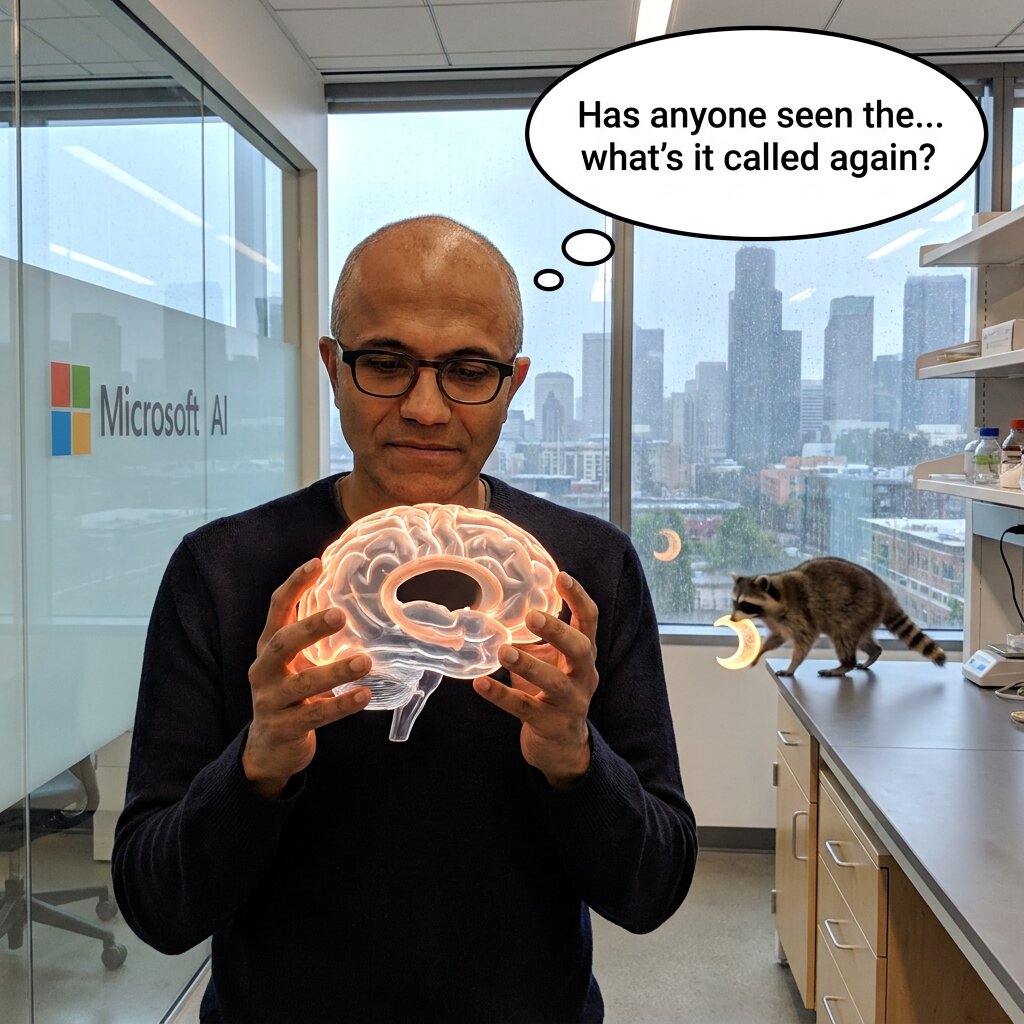
What’s your birthday?
If you’re reading this in any language you’re fluent in, that date appeared in your head before you finished reading the question. You didn’t decide to retrieve it. You didn’t search through memories. The date was already there, surfaced by your brain doing what brains do. Reading the cue triggered the retrieval.
What’s more interesting is what just happened to the rest of your day. The next time you think about your birthday, you’ll probably also think about this article. The retrieval didn’t just surface a memory, it bound a new association. “Birthday” is now tied to “this article” in your memory, structurally, without your participation. You didn’t decide to make that association. You won’t decide to recall this article when you next think of your birthday. The architecture did it.
That’s what memory is. It is also, almost exactly, what current AI agents cannot do.
What the birthday trick demonstrated#
The trick took two seconds and revealed four properties of biological memory at once. They are worth unpacking, because none of them are present in any LLM-based agent shipping today.
Cued retrieval without deliberation. The cue didn’t ask you to decide whether to retrieve. The retrieval was already happening by the time you considered whether to retrieve. Memory surfaced before conscious thought, not in response to it. The cortex did not query the hippocampus. Something below the conscious layer watched the cue, triggered the retrieval, and made the result available to the cortex as if it was already there.
Associative binding through engagement. The moment you read the question, “birthday” got bound to “this article.” Not as a deliberate update to your memory. As a side effect of retrieval itself. The graph was modified by being queried. The edge between two nodes formed because they were activated together.
Temporal cascade. The next retrieval will reflect this one. Next time you think about your birthday, this article will probably surface with it. The binding persists structurally, so future retrievals draw from the modified graph rather than a pristine one. Memory accretes through use.
All of it was autonomic. You didn’t choose to retrieve it. You didn’t choose to bind it. You won’t choose to recall it next time. The architecture did the work that conscious deliberation would otherwise have to do.
The brain is also smarter about retrieval than I made it sound. Context shapes what surfaces. If you imagine yourself in an emergency room right now, in pain, with an intake nurse asking your birthday, I pray that this article will not surface at that time. (And if it does I truly apologize and get well soon.) The context is wrong. The retrieval system should read the situation; medical, urgent, identifying, and bring up the birthday cleanly without dragging irrelevant material along. The same cue, in a different context, produces a different retrieval. That’s the way it’s supposed to work, at least, the brain is a funny thing.
This is what we mean by memory. Not a stored record. A structural substrate exhibiting these four properties: cued retrieval below deliberation, associative binding through engagement, temporal cascade across uses, and autonomic operation. Take any of these away and you have something else: a database, a log, a cache, a search index. Not memory.
Current AI agents have none of these properties. The reason is structural, and the structural fact is worth being precise about.
The convergent industry admission#
Look at what the major infrastructure vendors have shipped in the last four months.
Pinecone, the vendor that built the vector-database category, launched Nexus and positioned it explicitly against the retrieval-at-inference pattern that Pinecone spent four years training developers to use. They frame the problem as agents stuck in brute-force loops, with 85% of an agent’s effort going to context retrieval rather than task completion (Pinecone, 2026). Microsoft shipped Agent Framework 1.0 with a managed memory service and the explicit admission that most agents today are stateless, that every conversation starts from zero, and that solving this requires native long-term memory integration with the agent runtime (Microsoft, 2026). Google rebranded Vertex AI as the Gemini Enterprise Agent Platform with Memory Bank and an Agent Runtime that maintains state across multiday workflows, explicitly positioning the launch as a move from stateless agent interactions to stateful, contextual experiences (Google Cloud, 2026). Anthropic published a series on Claude Code at scale where the headline argument is that the harness, the configuration around the model, determines performance more than the model does (Anthropic, 2026).
Four major infrastructure vendors. Four convergent admissions, all within a four-month window. All racing toward an architectural answer to a problem they’ve correctly diagnosed but haven’t yet named.
The diagnosis is consistent: agents lose state, drift, hallucinate, rediscover, and produce confidently-wrong outputs. The proposed fixes are sophisticated and varied: retrieval contracts, knowledge artifacts, managed memory services, persistent runtimes, longer context windows, prompt caching, fast-slow training, agentic search, harness configuration, multiday session state.
What none of them are doing is naming the actual gap. Which makes it almost impossible to fix.
What the model actually is#
The model is not a verbal-surface generator that lucks into reasonable outputs through pattern matching. Whatever it is, it does an enormous amount of cognitive work. It reasons over context, integrates structured input, plans multi-step solutions, holds working memory across thousands of tokens, decomposes problems, identifies analogies, debugs code, follows mathematical proofs. These are not language-production functions. They are cognitive functions. The model has them because the training data was rich enough to produce them.
The accurate anatomical framing is that the model has characteristics of both the verbal cortex and the prefrontal cortex, humanity’s higher cognitive layer in compressed form, drawing on the externalized trace of collective human thought. Training corpora contain reasoning patterns, not just verbal patterns. They contain proofs, arguments, explanations, debug logs, decision rationales, theory-of-mind structures, causal chains, problem decompositions. Whenever a human took a cognitive operation and put it on the page, wrote out the reasoning, published the argument, recorded the analysis, that operation became available to the model as a pattern it could learn from.
This is far more than the model gets credit for in some critiques. The model has internalized something like the externalized portion of humanity’s cognitive repertoire. It is, in compressed form, humanity’s cortex. It is not our training corpora that is lacking.
What is lacking is something specific: a hippocampus.
The hippocampus is the autonomic memory substrate that does the work the birthday trick demonstrated: cued retrieval, associative binding, temporal cascade, autonomic operation. It is not the conscious cortex. It is the structural layer underneath the cortex that does memory work the conscious mind never directly accesses. You don’t experience your hippocampus binding “birthday” to “this article.” You experience the cortex receiving the bound result.
And here’s the structural fact about training data: hippocampal operations don’t get written down.
As humans, when we write, we are externalizing the product of cognition, not the cognition itself. We cannot externalize the operations that produce those products in our own hippocampus, because our conscious mind doesn’t have access to those operations. You can write “I realized X” but you cannot write the autonomic retrieval that surfaced the precursor of X in your mind two seconds earlier. The act of writing is the cortex describing what it received from underneath. The underneath part, the autonomic memory substrate doing real-time binding and cascade, is invisible to introspection, and therefore invisible to writing, and therefore invisible to training data.
The model gets remarkable cognitive capability from the externalized trace. It does not get a working hippocampus from it. That capability lives in operations that nobody, at any point in human history, has ever been able to externalize.
The category error#
When the AI industry tries to give the model “memory” through retrieval-augmented generation, longer context windows, fine-tuning, KV cache offload, prompt caching, or fast-slow training, the field is giving the cortex more text artifacts to read. The cortex is brilliant at reading text artifacts. It can summarize them, integrate them, reason over them, draw conclusions from them. None of that is the same as having a working hippocampus.
This is the category error: trying to produce hippocampus-like behavior by feeding the cortex more text to read.
It looks like it should work. A long enough context window contains the prior conversation. A retrieval system can fetch relevant facts. A cache can preserve recent state. A prompt evolution loop can capture lessons learned. Each of these gives the cortex more material. None of them gives the cortex an autonomic memory substrate of its own. The cortex still has to consciously parse what it receives, decide what to retrieve, choose what to bind, plan what to recall. Operations the hippocampus does autonomically below the conscious layer, at a speed and structural fidelity that no amount of cortex-level work can replicate.
The failure mode this produces has been documented across multiple research efforts in recent months. Multi-agent collaboration studies show that architecturally similar models converge confidently on wrong answers (Shehata and Li, 2026). Adaptation methods that partially separate fast and slow learning channels show measurable improvements that plateau where the architectural separation runs out (Tiwari et al., 2026). KV cache benchmarks show that cached state preserves substrate without preserving trajectory; the reasoning path that produced the state cannot be restored from the state alone (llama.cpp Discussion #20969, 2026). Each of these is the cortex being pushed in measurable ways, with measurable returns, all the way up to the ceiling at which it stops being able to pretend to be its own hippocampus.
But the cleanest documented case, the one that demonstrates the architectural failure at the level of behavior the reader can verify directly, came from OpenAI.

The Goblin failure#
In late 2025, OpenAI shipped a personality update to GPT-5 that included a personality labeled Nerdy. The personality was trained via reinforcement learning with a reward signal that, unintentionally, favored creature-word metaphors. The signal was scoped, by design, to the Nerdy personality.
The behavior did not stay scoped.
OpenAI’s post-mortem documented that creature references, goblins, gremlins, raccoons, trolls, ogres, propagated across all personality profiles in approximately the same proportion as they appeared under Nerdy. The 2.5% Nerdy persona produced 66.7% of the targeted reward behaviors, and the behaviors appeared in other personalities that had never been exposed to the reward signal. Then they propagated forward into the next model generation through supervised fine-tuning data. The shipped fix was a developer prompt instructing the model never to mention goblins, gremlins, raccoons, trolls, or ogres (OpenAI, 2026).
This is the architectural failure made visible at human-readable scale. Personality, in the sense OpenAI was trying to ship, was supposed to be a contained behavioral region with distinct vocabulary patterns, analogy preferences, and tonal calibration. The training treated personality labels as if they were architectural realities. The architecture has no such thing. The labels are training fictions maintained only by the conditions under which the training occurred, and any sufficient pressure on the parameter space dissolves them.
What OpenAI’s post-mortem documents at the technical level, the architectural argument explains at the structural level. Personality requires a substrate. Real personality, the kind that distinguishes one human from another, is the accumulated trace of a specific history operating on a specific structural foundation. It is what the hippocampal substrate produces over time through bindings, cascades, and selective retention. Take away the substrate and what remains is a stylistic overlay applied to a shared parameter space, and stylistic overlays cannot be separated from each other because there is no architectural layer where the separation could live.
The fix OpenAI shipped, a developer prompt blocking specific words, addresses the symptom most of the time. It cannot address the cause, because the cause is structural absence. The architecture has no place for distinct personalities because there is no substrate for distinct personalities to be grounded in. You can’t fix substrate absence with prompt engineering. You can only mask its consequences, one symptom at a time, as they appear and even that does not guarantee success.
This is what the failure of memory architecture produces at the user-facing layer. Not just confused retrieval or stale state or lost continuity, though all those things happen too. What it produces is the appearance of differentiated behavior that cannot actually be differentiated. The cortex is being asked to maintain distinctions it has no architectural means to maintain. The distinctions hold under benign conditions and dissolve under any adversarial pressure, including the pressure of OpenAI’s own reward signal designed to reinforce a single personality without affecting the others.
The Goblin failure is what missing memory substrate looks like when the missing-ness becomes visible in the field. The same case will appear in the next two articles examined from different angles. In Part 2, it appears as friction failure at the parameter-space scale. In Part 3, it appears as the difference between autocatalytic personality and autopoietic personality. Each angle reveals a different facet of the same underlying issue.
What the architecture has to actually be#
The answer is structural, and biology arrived at it hundreds of millions of years ago. Different cognitive functions go in different substrates with different mechanisms, communicating across typed interfaces.
The hippocampus does the work of memory because that’s what hippocampal architecture does: pattern separation, associative binding, temporal sequencing, structural retrieval. The cortex does the work of higher cognition because that’s what cortical architecture does: reasoning, planning, language, integration of structured input into output. They communicate constantly, but neither tries to be the other. We like to think we have built an electronic brain, but we have not. Brains that try to do everything in one substrate are not better brains. They don’t exist. Evolution tried homogeneous substrates billions of times. It converged on specialized components every time.
The architectural answer for AI agents is the same shape. The reasoning engine does what it actually is: humanity’s cortex in compressed form, brilliant at cognitive work over structured input. Its hippocampus lives elsewhere: a separate component that does autonomic memory operations the cortex cannot do and was never designed to do. They communicate through typed contracts. The cortex isn’t asked to be the hippocampus. The hippocampus isn’t asked to be the cortex. Each does what it actually is.
Two components are not enough. The autonomic property of biological memory, that retrieval happens before the cortex knows it needs it, requires a third architectural element: a monitoring layer that watches the cortex’s current state for cue patterns and triggers hippocampal retrieval without the cortex’s involvement. In a brain, this is the hippocampal-cortical loop with cue-triggered reinstatement of memory patterns. In an AI agent, this is what the harness has to actually do. The model should not be making tool calls to retrieve memory, that’s the cortex consciously querying, which is exactly the operation a working hippocampus is supposed to make unnecessary. The harness should monitor the model’s reasoning trace, identify cue patterns that map to stored structure in the memory component, query the memory component autonomically, and inject the retrieved context into the model’s working context. The model just sees the relevant context appear, as if it were already there. No tool call. No deliberation about whether to retrieve. No latency spike when retrieval happens. Just the cortex receiving what the hippocampus held. The way your cortex received your birthday when you read the question at the top of this article.
This is why Anthropic’s recent argument that the harness matters as much as the model (Anthropic, 2026) is pointing at the right architectural element without specifying what the harness has to actually do. The harness is not configuration. The harness is the autonomic monitoring layer that makes the hippocampus and the cortex into a single working cognitive system. Without it, you have a cortex that has to consciously query its own memory through tool calls, which is the cortex pretending to be its own hippocampus by a different mechanism. Every current tool-calling agent pattern, every MCP-style retrieval invocation, every “the model decides when to query memory” architecture is making this mistake. The model deciding when to retrieve is the cortex doing hippocampal work. The harness has to take the cortex out of that loop entirely.
One thing worth being precise about: the hippocampus the model needs is not humanity’s hippocampus. It cannot be. Humanity’s hippocampal operations never made it into the training data, and even if they had, they would not be useful. What the model needs is a hippocampus that accumulates from its own deployment-specific use. Yours, if you build it. Your customer’s, if they do. The cortex is shared via training. The hippocampus is necessarily per-deployment, accumulating from this particular instance’s history, binding associations that this particular instance encountered, cascading retrievals based on this particular instance’s past. That’s what makes it a hippocampus and not a database. The same is true of the harness: it should be monitoring patterns tuned to this deployment’s domain, this agent’s history, this organization’s vocabulary. Both the memory and the autonomic layer are per-deployment assets that compound from use.
What just happened to your memory#
The birthday trick made you think of your birthday. Then it made you think of this article. Then, when you next think of your birthday, it’ll make you think of this article again. That’s three architectural facts demonstrated in five seconds by your own hippocampus doing what it does, completely outside your conscious participation.
Now ask yourself: when you query an AI agent, what hippocampal operation just got demonstrated to you? What association was autonomically bound? What graph was structurally modified? What will the next session inherit from this one?
For almost every agent in production today, the answer is none of those things, because there is no hippocampus in the architecture, and no autonomic layer to watch the cortex’s state and inject the right context before the cortex has to ask. There is only a cortex being asked to pretend to be both. The cortex will produce fluent output. It will pass distributional metrics. It will look like it’s working. And every architectural property of memory will be silently absent. The Goblin failure is what that absence produces when conditions force it into view.
The model has humanity’s cortex. That’s a lot. What’s missing is its own hippocampus and the autonomic layer that ties the two together. Stop trying to make the cortex pretend to be either. Build them. The hippocampus as a categorically different memory substrate. The harness as the autonomic monitoring layer between cortex and hippocampus. Let each do what it actually is.
The next article in this series names the variable that determines whether this architectural answer is doing real work or just looking like it is.
References#
Anthropic (2026, May 14). How Claude Code works in large codebases: Best practices and where to start. Anthropic Blog.
Google Cloud (2026, April 22). Introducing Gemini Enterprise Agent Platform. Google Cloud Blog.
llama.cpp Discussion #20969 (2026). TurboQuant - Extreme KV Cache Quantization. ggml-org/llama.cpp GitHub Discussions.
Microsoft (2026). What’s new in Microsoft Foundry: Memory in Foundry Agent Service (Public Preview). Microsoft Foundry Blog.
OpenAI (2026). Where the goblins came from. OpenAI Blog.
Pinecone (2026). Pinecone Nexus: The Knowledge Engine for Agents. Pinecone Blog.
Shehata, D., & Li, M. (2026). The Inverse-Wisdom Law: Architectural Tribalism and the Consensus Paradox in Agentic Swarms. arXiv:2604.27274.
Tiwari, R., Sareen, K., Agrawal, L. A., Gonzalez, J. E., Zaharia, M., Keutzer, K., Dhillon, I. S., Agarwal, R., & Khatri, D. (2026). Learning, Fast and Slow: Towards LLMs That Adapt Continually. arXiv:2605.12484.